A Christmas story 

I’m not what you might call a religious person.

So the fact that I found myself in the High Church of Capitalism, also known as Walmart,  on Christmas Eve day was, to say the least, unusual. But sometimes a man’s gotta do what a man’s gotta do. And in this case what a man had to do was provide for his family by securing a set of tire chains for traveling up into the mountains. We would be celebrating Christmas there. A fresh blanket of the white stuff had just fallen and the only way to reach our destination would be with chains. And apparently the only place that carried them was Walmart.

I arrived in the parking lot of the biggest of big box stores at 7:08 a.m. The place was already buzzing, but inside it was relatively calm. A Christmas miracle right there. I asked for directions to the automotive/hardware department and an employee, who was quite cheerful given the day ahead and the prospect of earning below minimum wage, guided me to the back of the store.

I looked out to the horizon, past the acres of plastic toys, synthetic clothes and 200,000 other unnecessary items on the shelves and proceeded on a brisk hike. I arrived at my destination and found the automotive accessories. There was one shelf completely empty. I knew immediately what this signified.  I wasn’t the only one who had this idea. The entire population of Bay Area residents was also planning on being in the snow for Christmas. Every box of tire chains at our local Walmart had been wiped out.

But then a little sparkle of something blue on the bottom shelf caught my eye.  It was the very last package of chains, hiding in the corner and waiting just for me. Another Christmas miracle.

As I laid my hand on the gift from heaven, or maybe from Saint Sam Walton, another customer came around the corner. He stopped, stunned at the sight. In a timid voice he asked: “Is that the last one?”

“I’m afraid so,” I said.

He smiled, trying to conceal his disappointment. I knew what he was thinking: If Walmart, which has everything in the entire world, didn’t have tire chains, there would be none to be found anywhere.

This put me into a quandary. Here was a humble father in need, trying to reach his destination, just like Joseph. What if his Mary was sitting in his car in the Walmart lot, waiting patiently? How would they make it to Bethlehem?

What was I to do?  Would I be the Good Samaritan and help the blessed couple (soon to be three, no doubt) on their way? Or would I show the indifference of the innkeeper and turn them away?

I took the box to the cash register and high-tailed it out of the store. After all, it was his family vs. mine. As anybody who has ever been in a Walmart knows, it's all about survival of the fittest.

Merry Christmas.


--George

College Circuit 

It’s gratifying to see that in this day of age of social media and smart phones everywhere that college radio is still alive and well.
 
Last night we did a gig at KZSU 90.1 FM in the Bay Area. This is Stanford University’s station.
 
KZSU is housed in a dingy little basement (where else), but the atmosphere is, well, electric. The staff is comprised of volunteers and boy do they love doing what they’re doing.
 
We set up, played live, spun a few tunes from our upcoming album, and chatted with the host. The hour flew by.
 
We highly recommend this venue for Bay Area artists.

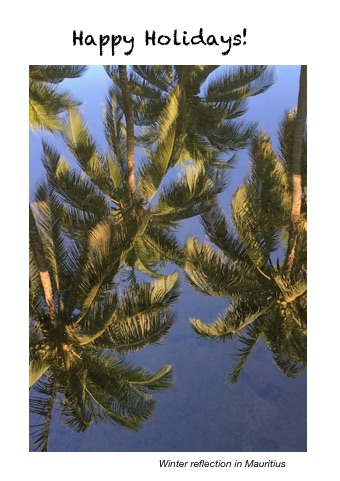
Our Holiday Card 

So why a balmy, tropical beach scene for our yuletide greeting?

And why do the coconut trees seem to be upside down?

A few reasons (or maybe a bit of rationalization).

First, about the image: It captures a watery reflection on a winter's day in Mauritius, a tiny island nation out in the Indian Ocean, about 2,000 kilometers off the eastern coast off Africa.

It is considered part of that continent but is not to be confused with Mauritania, another African nation on the western seaboard. Mauritius was one of the last pieces of land on earth discovered (invaded?) by humans, who, doing what they do best, proceeded to wipe out another species, the Dodo bird. The atoll is below the equator, at about the same latitude south as Hawaii is to the north and, hence, has a very similar climate. The photo was snapped in late June, the start of summer in the northern hemisphere and conversely the onset of winter in the southern hemisphere.

 
So what we have is an upside-down image of tropical trees taken in the southern hemisphere in winter there  to express a warm "Happy Holidays" during the northern hemisphere's chilly season.
 
One of the most remarkable things about Mauritius is its culture. You will see Buddhist and Hindu temples, Islamic mosques and Catholic churches. And they seem to get get along just fine. One reason might be the entire country (about 1.3 million people) celebrate (i.e. take a day off) for each religion. That's a pretty clever incentive.

Peace on earth and good will to all.

The root of all evil 

We have been battling with a most vexatious weed in our yard. It seems capable of propagating anywhere, sprouting to a couple feet in height with incredible speed and agility. Its tenacious roots anchor defiantly in the soil, making it almost impossible to pull out. Grabbing the thing isn’t easy, either. It defies hand-to-hand combat, defending its turf with prickly, contorted leafs that get the message out to keep your distance.

Meanwhile, our little quarter-acre lot is run rampant with squirrels. And from the looks of things, they are as healthy and happy as can be. They’re going nowhere, content to obliviously dig up newly seeded grass or uproot lovingly planted flowers. They’re on a frantic mission to bury (and subsequently forget) their nutty treasures.

It took awhile, but we finally made the connection between the “weeds" and the squirrels. And I’m somewhat embarrassed to even admit it, given I have been living in California nearly my entire adult life and should be at least nominally acquainted with the native vegetation. But thanks to modern technology (i.e. a newly installed app on the phone) we were able to photograph and identify the plant.

It turns out the “weed” is actually quercus agrifolia, otherwise known as Coast Live Oak. These plants clearly haven’t been taking root of their own accord. They have had a little help from their bushy-tailed friends.

Our own mini-ecosystem in action.

Well, if you can’t beat ‘em, join ‘em. So we took the time to laboriously replant one of the oak trees. We’ll see how well it grows with a bit of kindness instead of hostility.

Our enemy has become our friend, now that we have been educated to overcome our ignorance of what was once considered a foreign intruder.

--George

Our humble harvest 

Throughout the summer and fall, we endured endless photos and postings from friends and family about their bountiful gardens.

We looked on in envy and awe at the cornucopia of fruits and vegetables that people seemed to effortlessly grow. Tomato plants the size of Christmas trees. Carrots that could double as police batons. Watermelons with such heft they require power machinery to hoist onto the table.

“We don’t even know what we’re doing,” they say, as though that should be consolation.

Or our favorite: “These cucumbers just sprouted in the compost heap.” Thanks. Now we feel better.

We bite our tongues, refraining from saying what we’re thinking.

That’s because there's something funny going on in our yard.
Everything we grow is stunted. Things ripen as they should. And they appear and taste normal. They’re just teensy tiny replicas of their respective species.

It’s not for lack of water. We’ve got drip irrigation and hoses everywhere. It’s certainly not on account of the soil. We’ve hauled in cubic yards of organic matter that’s so expensive they sell it by the ounce. Sunshine? Got plenty. As for tender loving care, we weed and till the ground and prune our leafy compatriots day and night.

Still, our harvest is on such a diminutive scale, we could fit it all in a doll's house.

Perhaps our little quarter-acre plot is some sort of self-contained ecosystem. Maybe the plants are adapting and evolving, using less resources to survive. It’s a well known phenomenon titled “Island Dwarfism.”

It certainly seems to apply to the plants. But apparently no one told the mammals. We’ve got more than our fair share of squirrels and they are as big, fat and happy as can be.

--George


Season of Sharing 


George
Years ago, I decided to have a little holiday dinner party. As I returned from the grocery store I was greeted eagerly by son Anthony, then 7, who, like most growing boys, has a fascination with food.

As we brought the supplies into the house, he interrogated me about the menu.

I ran through the list and then said:

“And just for you, I got dessert.”

His eyes lit up.

“You did? What did you get?”

“Pie,” I said.


“Mmm, I love pie,” he said.

“Me too,” I said.

The gleam in his eyes turned to one of concern.

“You do?” he asked, somewhat tentatively.

“Yes,” I said, "I really do."

I could see he was trying to figure something out. And then a look of resignation appeared.

“Well,” he said, “You want half?”

A perfect day 

Wake up after 11 hours, feeling fully recovered from jet lag, travel, visiting and feasting.

Decide upon plan for day: 1. Go on diet 2. Put up Christmas lights 3. Build fire in fireplace.

Look for diet food. None in house. In fact, no food of any kind in the house.

Go to grocery store. Buy food.

Return home.

Check weather for showers before putting up lights.

Put up lights. Showers ensue.

Go inside to build fire.

Realize no fireplace grate exists.

Go outside in rain and fire up welder. Make grate.

Put fireplace grate in fireplace. Light fire.

Realize fires are really nice with wine and music.

Pour and drink wine. Get out guitars and make our own music.

Time for dinner.

Since it’s been several hours of dieting, time for real food. Make lasagna and pie.

Eat said items.

Go back to fire, now dying down.

Realize embers would be perfect to roast marshmallows.

No marshmallows.

Make grocery list for tomorrow: 1. Marshmallows.